AI Content Generation Best Practices That Build Trust
Publishing more content is easy when AI can draft a page in seconds. Publishing useful, accurate, recognizable content that earns attention and leads is the harder job. That is where AI content generation best practices matter.
For early-stage businesses, the right goal is not to automate every word. We use AI to reduce blank-page time, organize research, create useful first drafts, and repurpose proven expertise. Then we apply human judgment, customer knowledge, and careful review before anything represents the brand.
Treat AI as a Production Partner, Not the Publisher
AI works best when it handles repeatable production tasks while people retain responsibility for strategy, facts, brand voice, and final approval. A fast draft is valuable, but an unreviewed draft can damage trust faster than it saves time.
A 2025 Ahrefs study of 879 marketers found that 97% review or edit AI-generated content, and 80% manually review it for accuracy. That is the standard worth following: use automation for speed, not as a substitute for accountability.
For a SaaS founder, AI can turn customer-call notes into a first-draft onboarding guide. For a contractor, it can organize common homeowner questions into service-page outlines. For an ecommerce store, it can create product-description variations from approved specifications. In each case, a real person must confirm the details, promises, pricing, and tone.
Keep humans responsible for the high-risk parts
We recommend reserving human review for any content that includes:
- Health, legal, financial, safety, or compliance guidance
- Product claims, comparisons, guarantees, prices, or availability
- Customer stories, reviews, testimonials, and performance results
- Local service details, licensing, credentials, and location coverage
- Advice that could materially affect a buyer’s decision
A practical rule is simple: if a customer could act on the statement, someone qualified should verify it.
Build a Brief Before You Write a Prompt
Strong output begins with a strong assignment. Vague prompts produce vague pages, no matter which AI platform you use.
Before drafting, create a short content brief that answers these questions:
| Brief Element | What We Define | Example |
|---|---|---|
| Business goal | What the page should accomplish | Book estimate requests |
| Reader | Who needs the answer | Homeowners with roof leaks |
| Intent | What they are trying to do | Compare repair options |
| Proof | What makes the page credible | Licensed team, local project photos |
| Next step | What readers should do | Request an inspection |
This prevents a common early-stage mistake: publishing general articles that get impressions but do not help a specific buyer move forward. A local dentist needs different content from a B2B software company, even when both target a broad topic like customer retention.
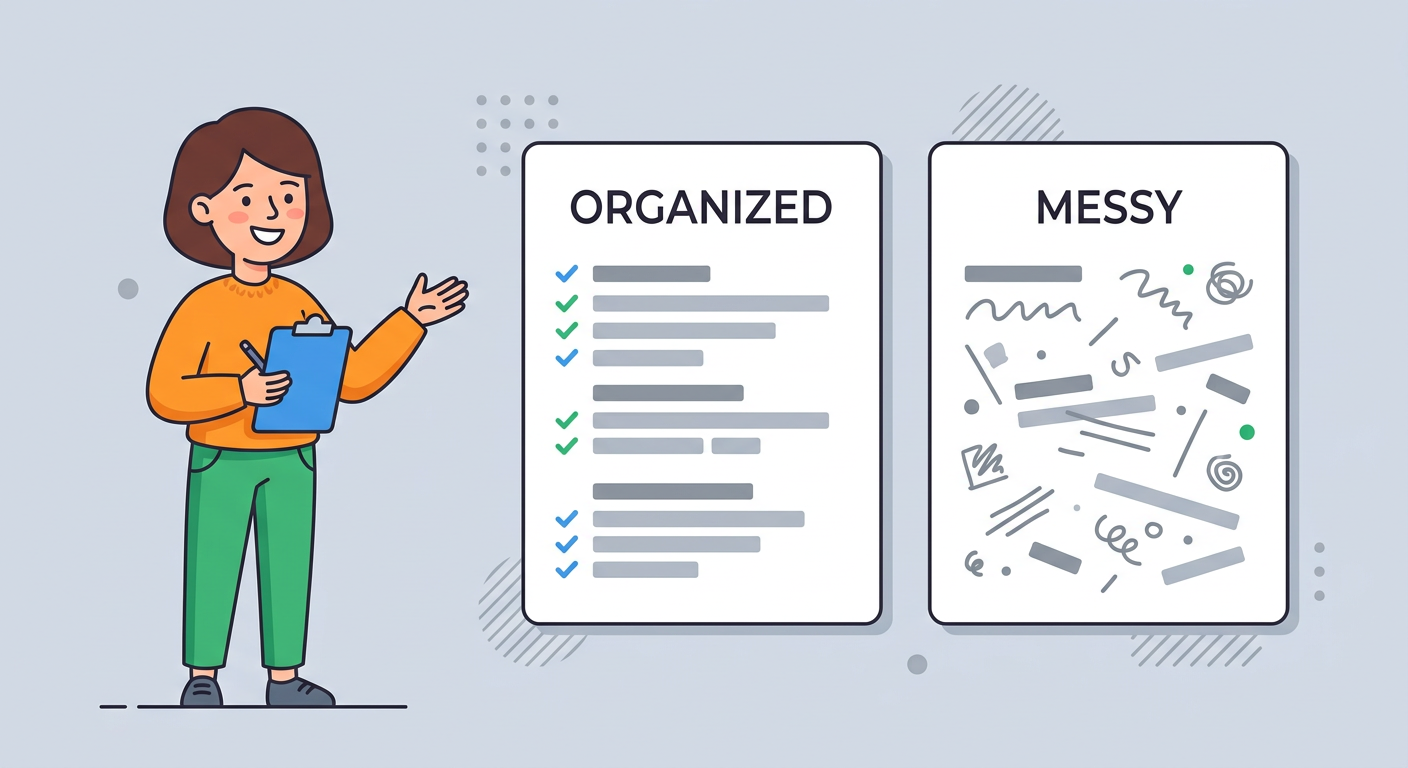
Use a prompt framework your team can repeat
We get more reliable drafts by including six inputs in every prompt:
- Role: Ask the tool to act as a content assistant for a specific industry.
- Audience: Describe the reader’s experience level, worries, and desired result.
- Page goal: State the conversion action or educational outcome.
- Source material: Provide approved facts, notes, product details, and examples.
- Voice rules: Set the tone, banned claims, reading level, and formatting preferences.
- Quality checks: Require clear sections, unanswered-question gaps, and claims marked for verification.
For example: “Draft a service page for homeowners considering AC repair. Use a calm, plainspoken tone. Only use the supplied pricing ranges and service details. Flag every factual claim that needs confirmation. Include a short checklist of signs a repair is needed and end with a request-an-estimate section.”
That prompt gives the system a job, boundaries, and evidence. It is far more useful than asking it to “write an SEO page about AC repair.”
Start Small With a 14-Day Content System
Early-stage companies do not need a massive content library. They need a repeatable process that connects one core topic to pages that answer real customer questions.
During the first 14 days, we suggest building a focused foundation rather than trying to publish daily. Start with a single business priority, such as increasing demo requests, generating local leads, or improving sales for one product category.
Days 1 through 4: Capture customer language
Review sales calls, support tickets, online reviews, quote requests, and emails. Pull out the actual phrases customers use, including objections such as “How much does it cost?” or “Will this work for a small team?”
Build one document with three columns: question, customer wording, and the best internal expert who can answer it. This becomes your raw material for content that sounds useful instead of generic.
Days 5 through 9: Publish one high-intent page
Create the page closest to revenue. It might be a core service page, a product comparison, a pricing explainer, or a location page with genuine local details.
Make the answer obvious near the top. Include original proof such as photos, process details, FAQs, examples, certifications, screenshots, or a concise explanation of what happens next. AI can shape the draft, but only your business can supply the experience that competitors cannot copy.
Days 10 through 14: Add supporting content and measure
Publish two supporting pieces that answer adjacent questions. A plumbing company could pair a water-heater replacement page with articles about replacement timing and tank versus tankless options. A SaaS company could pair a feature page with an implementation checklist and a comparison page.
Then connect the pages with descriptive internal links. A topical keyword map helps assign a clear target topic to each page so your site grows as a connected resource instead of a pile of isolated posts.
Make Every Draft Earn Its Place
AI makes it tempting to publish content because it is available, not because it is needed. The better approach is to ask whether each page gives the reader something specific they could not get from a dozen similar results.
In June 2026, Gartner reported that 49% of U.S. consumers agreed generative AI had made available content worse. The lesson is direct: more volume will not rescue weak material. Distinctive expertise will.
Add evidence AI cannot invent
Before approving a draft, strengthen it with business-specific material:
- A step-by-step process your team actually follows
- Original product screenshots or project photos
- A technical explanation from a qualified specialist
- Before-and-after outcomes with appropriate context
- Common mistakes your customers make and how you solve them
- Quotes from the people who deliver the service
These details make content more accurate, more memorable, and more valuable for both human readers and AI-driven discovery tools.
Improve structure for readers first
Use a direct answer beneath each heading, short paragraphs, clear labels, and lists only when they simplify a decision. Avoid padding an article to hit an arbitrary word count.
For a useful quality check, run the page through a free AI website audit to identify gaps in structure, intent alignment, topical coverage, and visibility signals. We should fix the highest-impact issues first, then review performance before expanding into lower-priority topics.
Create a Review Workflow That Protects Your Brand
A simple approval system is more valuable than a complicated AI stack. It gives your team a clear line between a useful draft and publish-ready content.
Use this five-step review sequence
- Fact check: Confirm every statistic, date, feature, credential, and claim against a trustworthy source.
- Brand check: Replace generic phrases with the language customers hear from your team.
- Intent check: Confirm the page answers the reader’s actual question early.
- Proof check: Add experience, examples, visuals, or expert input that supports key claims.
- Conversion check: Make the next action clear without pressuring the reader.
Gartner has also warned that AI systems can miss nuanced emotional and cultural context, particularly when brands rely on them without ongoing oversight. Its guidance on training AI for on-brand content reinforces the same principle: AI supports creative work best when it operates within clear brand rules and human governance.
Measure Business Outcomes, Not Just Publishing Speed
Success is not the number of drafts created. Success is whether the right pages attract qualified visitors, answer questions, and contribute to leads, sales, subscriptions, or repeat customers.
Track a small set of metrics for each content cluster:
- Organic visits to commercial pages
- Rankings for the page’s primary topic
- Qualified leads, calls, trials, or purchases
- Engagement with internal links and calls to action
- Assisted conversions from supporting articles
- Brand mentions in AI answers for priority customer questions
For SEO visibility, use an SEO website audit alongside regular content reviews. This helps us see whether weak results stem from the content itself, technical issues, an unclear keyword-to-page match, or a gap in topical depth.
Frequently Asked Questions
Can we publish AI-generated content without editing it?
We should not publish AI-generated content without editing it. Even a well-written draft can include outdated details, unsupported statements, or wording that does not match your customers or brand standards.
Does Google penalize content simply because AI helped create it?
No, the important issue is quality and usefulness, not the tool used to produce a draft. Content that is inaccurate, repetitive, thin, or created mainly to manipulate rankings creates risk regardless of whether AI or a person wrote it.
How much time can AI realistically save our team?
AI can save substantial time on outlines, first drafts, repurposing, metadata, and content organization. The exact savings depend on your review requirements, but you should plan for human time to verify claims and add original expertise.
What should a small business create first with AI?
Start with a high-intent page that supports a direct business goal, such as a core service page, a product comparison, a pricing explainer, or a frequently asked customer question. Do not begin with broad thought-leadership articles that have no link to a revenue path.
How do we keep AI content from sounding generic?
Give the system specific source material, examples, customer language, and voice rules before it drafts. Then replace broad statements with your real process, people, proof, and point of view during review.
Should we disclose that we used AI to create content?
Disclosure depends on your industry, audience expectations, and the role AI played in production. When AI materially creates customer-facing content, transparency can support trust, especially in regulated or high-stakes categories.
Put Your Content Plan on Firmer Ground
A strong AI content process starts with a clear business goal, a detailed brief, human review, and evidence only your organization can provide. The businesses that stand out will not be the ones publishing the most pages, but the ones consistently answering customer questions with accuracy, proof, and a recognizable voice.
If you want a clearer view of what to prioritize, visit Marvlus for a free AI website audit, topical mapping, SEO and rank tracking, and AI mention monitoring across major AI platforms. Use the findings to choose one high-impact page, improve it thoroughly, and build your next content decisions from real signals.