Patients do not begin by comparing every provider in town. They often choose a few names based on what appears nearby, whether the information is accurate, and whether the practice feels credible before they ever make contact. That makes local SEO for healthcare practices a patient-trust system, not simply a rankings project.
For early-stage practices, the priority is clarity. We need Google, Maps, directories, AI answer tools, and prospective patients to see the same accurate story about your location, specialties, providers, insurance options, and next step for booking care.
What Local Visibility Depends On
Local visibility depends on relevance, distance, and prominence, plus a website that gives patients enough confidence to act. Google explains that complete business information, positive reviews, and helpful responses can support local visibility, while distance will always affect who sees a practice in map results.
| Priority | What We Improve | Patient Benefit | Early-Stage Goal |
|---|---|---|---|
| Google Business Profile | Categories, hours, services, photos | Fewer unanswered questions | Accurate profile |
| Location pages | Care, providers, directions, booking | Clear local relevance | One page per real location |
| Reviews | Ethical requests and safe replies | Stronger confidence | Consistent feedback flow |
| Local listings | Name, address, phone consistency | Fewer dead ends | Correct core directories |
| Helpful content | Service and symptom-related questions | Better-informed patients | Three core content clusters |
A 2025 BrightLocal consumer study found that 67% of consumers often or always look at reviews after a local business search, and 56% often or always check whether a business’s information matches other places online. For a medical, dental, therapy, veterinary, or wellness practice, that behavior is especially important because the decision involves personal trust.
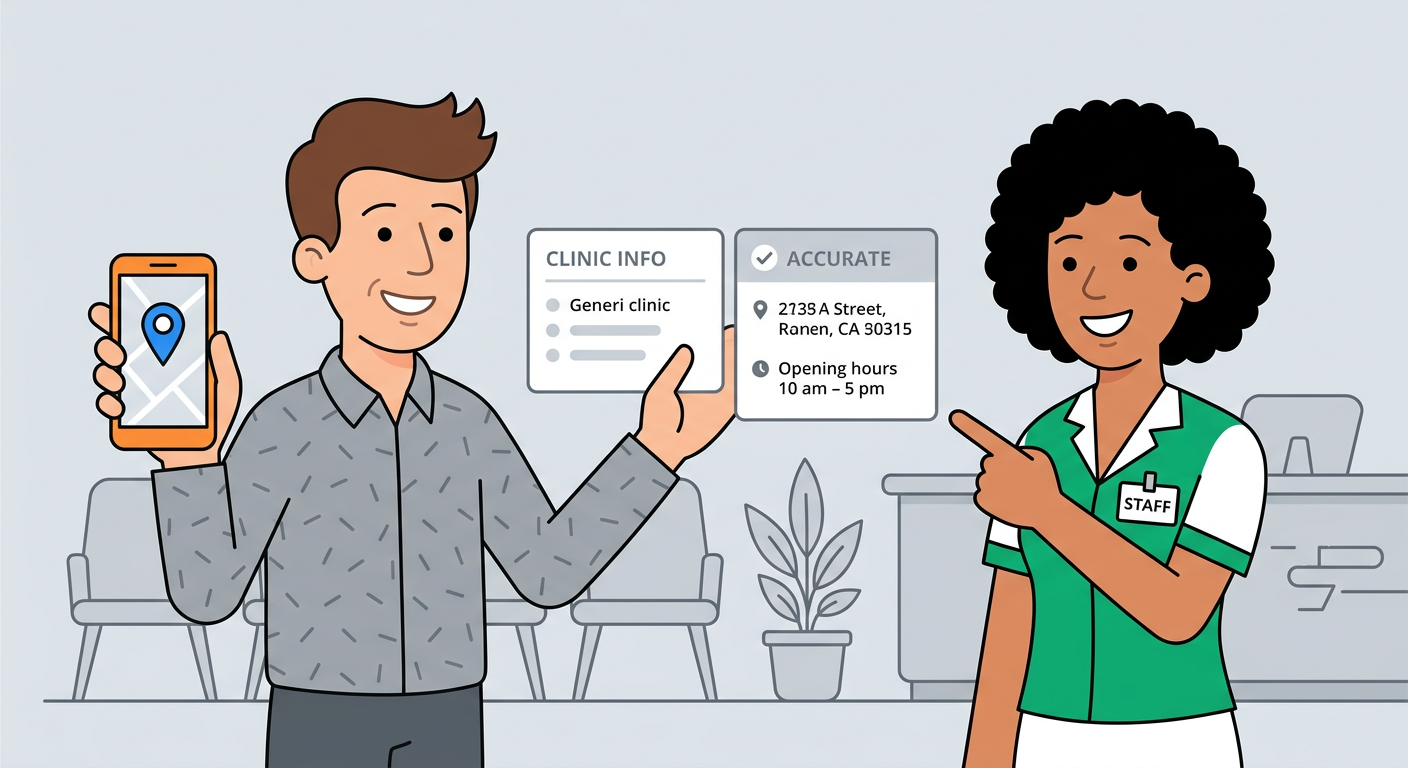
Make Your Google Business Profile Clinically Accurate
Your Google Business Profile is often the first local page a patient sees, so it must reflect real-world operations precisely. Treat it like a digital front desk that needs the right answers every day.
Start with the basics:
- Use the practice name shown on your physical signage and official materials.
- Select the most accurate primary category, then add only relevant secondary categories.
- Confirm the address, main phone number, website URL, hours, holiday hours, accessibility details, parking information, and appointment link.
- Add services patients actually seek, such as family dentistry, sports physicals, allergy testing, physical therapy, pediatric care, or urgent care.
- Publish recent photos of the exterior, reception area, providers, exam spaces where appropriate, and clear wayfinding details.
Google’s local ranking guidance is clear: detailed and current information helps it match a business with relevant local queries. Do not try to force every nearby city into your business name or create duplicate profiles for departments that patients cannot visit independently. Those shortcuts can create confusion and policy problems.
Build Location Pages That Help Patients Choose
A strong location page answers the questions that make someone hesitate before booking. It should explain where the office is, which care is available there, who provides it, and how a patient can take the next step.
For each real clinic location, include:
- The exact name, address, and local phone number
- Embedded map and simple directions from familiar nearby roads or landmarks
- Office hours, including urgent or after-hours instructions where applicable
- Services available at that specific location
- Provider names, credentials, and professional biographies
- Insurance, payment, referral, telehealth, and booking details
- Accessibility and language-support information when offered
Avoid copying one page and replacing the city name. A patient looking for a dermatologist in one neighborhood has different travel expectations, provider availability, and service needs than someone in the next city. Build pages around useful details, not a list of ZIP codes.
Add structured data carefully as well. Google’s LocalBusiness documentation recommends using the most specific business type available and supports details such as hours and departments. Markup helps machines interpret the page, but it cannot compensate for inaccurate content or weak patient experience.
Protect Privacy While Building Reviews
A review program can strengthen confidence, but healthcare practices must keep privacy and authenticity ahead of marketing. We should ask every eligible patient for honest feedback through the same neutral process, not reward positive comments or pressure patients during care.
Google permits businesses to request reviews through a direct link or QR code, but its review policy guidance prohibits incentives in exchange for reviews. Build the request into a post-visit workflow, such as a brief text or email after the appointment, and make it equally available to all patients.
Public replies require an extra layer of discipline. Never confirm that a reviewer is a patient, discuss treatment, explain a diagnosis, or correct clinical facts in public. The HHS HIPAA guidance for providers underscores the responsibility to safeguard protected health information.
A safe response can be simple:
Thank you for sharing your feedback. We take patient experience seriously. Please contact our office directly so our team can help.
Have a privacy officer or compliance lead approve response templates. That gives the front desk a faster, safer way to acknowledge feedback without creating an avoidable disclosure.
Use a Progressive Content Plan, Not Random Blog Posts
Early-stage practices should build local authority in layers. We do not need fifty generic articles before fixing the pages that convert local intent into booked appointments.
Days 1 Through 30: Establish the Local Foundation
First, audit the Business Profile, website contact details, major healthcare directories, and each location page. Correct conflicting hours, old provider names, broken appointment links, duplicate phone numbers, and outdated addresses before publishing more content.
Then create or improve three high-value pages:
- A primary location page
- A primary service page
- A provider or care-team page
For example, a new physical therapy clinic could focus on “physical therapy in Austin,” “sports injury rehabilitation,” and a care-team page that explains each therapist’s areas of focus. These pages support the questions patients ask when they are close to choosing a provider.
Days 31 Through 60: Expand Around Real Patient Questions
Next, publish supporting pages tied to your most valuable services. A pediatric practice might create pages on same-day sick visits, newborn care, sports physicals, and vaccine appointment preparation. A dental office may focus on emergency dentistry, dental implants, teeth whitening, and what to expect at a first visit.
Each page should answer a specific question, provide medically responsible information, name a qualified reviewer where appropriate, and link to the relevant service and location pages. This is how we turn a basic brochure site into a connected resource.
Our article on building topical authority explains why related, internally connected pages make a site easier for people and search engines to understand. For healthcare, the goal is not volume. It is creating an organized library that reflects your actual expertise.
Days 61 Through 90: Measure, Refresh, and Extend
By the third month, review which service pages receive impressions, which queries bring local traffic, where patients abandon the booking path, and which listings still contain inconsistent information. Strengthen pages that are close to page-one visibility before starting a brand-new subject.
This is also the right point to add a small number of local trust signals, such as links from professional associations, local hospital affiliations, community organizations, or event partnerships. Relevance matters more than volume. One respected local connection is more valuable than a batch of low-quality directory links.

Prepare for Local Discovery Beyond Google Maps
Patients are increasingly asking full questions in AI tools and checking more than one source before they book. That means your online information needs to be consistent, factual, and easy to interpret across your website, Business Profile, reputable healthcare directories, and local community sources.
Create concise answers to questions such as:
- Do you accept new patients?
- Which insurance plans do you accept?
- Is same-day care available?
- Which ages do you treat?
- Do you offer telehealth?
- What should a patient bring to their first appointment?
Answer-first pages also help conventional organic visibility. For a broader view of how answer engines interpret brand and topic signals, read what generative engine optimization means for website owners. The practical takeaway is simple: make your practice easy to verify, not difficult to interpret.
Questions Practice Owners Ask
How long does local SEO take for a healthcare practice?
Most practices see foundational improvements after several weeks, while sustained gains commonly take three to six months. Timelines vary with competition, proximity, existing reviews, website quality, and whether your listings already contain conflicting data.
Can one medical practice have multiple Google Business Profiles?
Yes, if each location is a real, staffed office that patients can visit during its listed hours. Do not create extra profiles for service areas, individual keywords, or virtual offices that do not meet Google’s eligibility requirements.
Should every provider have a separate profile?
It depends on how independently the provider is publicly recognized and how patients book with them. A multi-provider practice should review Google’s guidelines carefully before creating practitioner profiles, because duplicate or confusing listings can dilute visibility.
Is it safe to respond to negative healthcare reviews?
Yes, but the response must stay general and privacy-safe. Acknowledge the concern, invite an offline conversation, and never reveal information that confirms a treatment relationship or discusses care details.
Do healthcare practices need separate pages for every nearby city?
No. Create a dedicated page only when you have a real location, a distinct service area with meaningful information, or unique local value to explain. Thin city pages usually create a poor experience and can weaken your site’s overall quality.
Are online reviews more important than clinical credentials?
Both matter, but they influence different parts of the decision. Reviews signal patient experience, while provider biographies, licenses, credentials, and clear service information show why the practice is qualified to deliver care.
See What Patients and AI Tools Can Verify
Local visibility improves faster when we work from evidence instead of assumptions. Marvlus offers free AI website audits, topical mapping, rank tracking, and AI mention monitoring so you can identify missing local signals, prioritize high-value pages, and see how your practice is represented across AI tools.
Start with one location, one core service, and one measurable patient action. Then use the findings to build a repeatable system for every additional office or specialty.
Build a Local Presence Worth Trusting
The strongest healthcare local SEO programs do not chase map rankings in isolation. They make it easy for patients to find accurate information, evaluate clinical fit, choose a location, and book with confidence.
Start by fixing the foundations: a precise Business Profile, trustworthy location pages, ethical review practices, and a content plan built around real patient questions. When those pieces work together, your practice becomes easier to discover and much easier to choose.