Most early-stage websites do not need more pages first. They need a clear diagnosis of why existing pages are hard to find, slow to use, vague about their offer, or disconnected from the questions potential customers actually ask.
A free AI website audit gives us that baseline. It helps us identify technical friction, weak content structure, missing trust signals, and opportunities to make a site easier for both people and AI-driven discovery tools to understand.
What a Free AI Website Audit Should Actually Tell Us
A useful audit should produce a ranked list of improvements, not a wall of generic scores. For an early-stage business, the best report tells us what is blocking visibility, which page deserves attention first, and what can wait.
Traditional SEO reviews often focus on crawling, indexability, links, and rankings. Those still matter. An AI-focused review also examines whether our brand, services, expertise, content structure, and supporting facts are clear enough to be understood and reused in AI-generated answers.
| Audit area | What we review | Why it matters first |
|---|---|---|
| Technical health | Mobile speed, broken pages, crawl access | Visitors and bots can reach key pages |
| Message clarity | Offer, audience, location, proof | People understand why they should choose us |
| Content structure | Headings, answers, FAQs, internal links | Important information is easier to extract |
| Topic coverage | Missing service questions and supporting pages | We build authority without publishing randomly |
| Visibility tracking | Rankings and AI mentions | We can measure if fixes are working |
For example, a local HVAC contractor may have a polished home page but no clear service-area pages, no explanation of emergency availability, and no proof of licensing or reviews. A SaaS founder may have product features documented everywhere but no page that plainly answers who the product is for, what problem it solves, and how it compares with alternatives. The first fixes are different, but the audit process is the same: find the gaps, prioritize them, then measure the result.
Start With the Pages Closest to Revenue
On day one, we should audit pages that can create a call, quote request, trial, booking, or sale. Fixing an old blog post can be worthwhile, but it rarely outranks clarifying a service page that already receives qualified visitors.
Build a short list of five URLs:
- Home page
- Primary product or service page
- Top location page, if local
- Highest-traffic blog or resource page
- Contact, pricing, booking, or checkout page
Then ask a blunt question of each one: can a first-time visitor explain the offer, audience, next step, and reason to trust us in under 15 seconds? If not, that is a higher priority than chasing a perfect technical score.
A strong page opens with a direct summary. It names the service or product, identifies the buyer, explains the outcome, and gives a specific next action. Add visible contact details, an accurate business address where appropriate, credentials, author information, testimonials, original examples, and policy links. These details make a website more useful for a customer and less ambiguous for machines trying to interpret it.
Use Performance Data, But Do Not Obsess Over a Single Score
Speed matters because slow pages interrupt the buyer journey, particularly on mobile. Still, a performance score is a diagnostic signal, not a business strategy.
Google recommends a Largest Contentful Paint of 2.5 seconds or less, an Interaction to Next Paint under 200 milliseconds, and a Cumulative Layout Shift below 0.1. Those are practical benchmarks for a faster, steadier experience, not guarantees of first-place rankings. Google Search Central also cautions that strong page experience alone does not guarantee top placement, because relevance and helpfulness remain central.
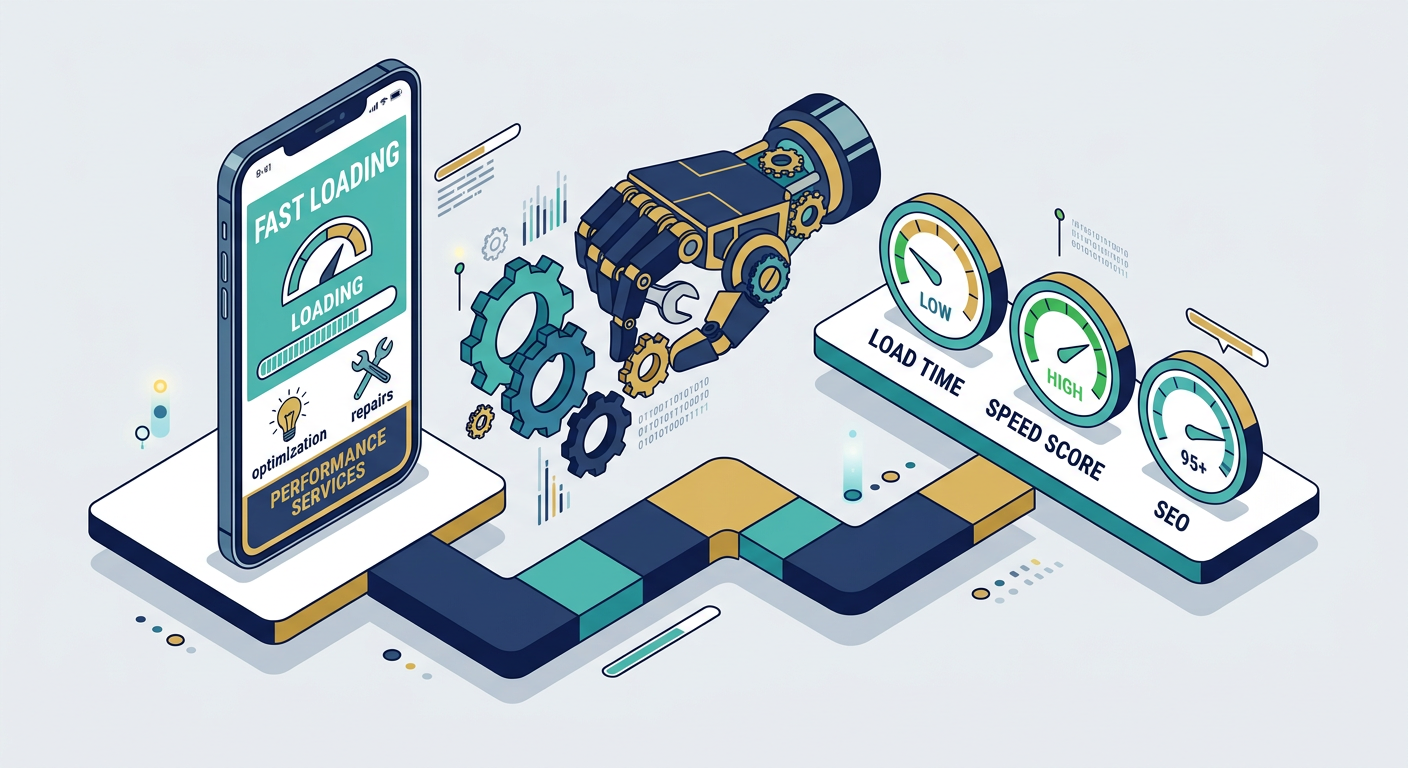
Use Google PageSpeed Insights to review real-user and lab data for key URLs. Its report separates field data from simulated diagnostics, which is useful because a lab test can reveal implementation issues while real-user data shows how visitors actually experience the page.
For an early-stage company, prioritize the fixes that are both visible and feasible:
- Compress oversized hero images and serve modern formats.
- Remove unnecessary apps, scripts, popups, and chat widgets.
- Reserve space for images, embeds, and banners to reduce layout shifts.
- Improve server response time and caching where the platform allows it.
- Test the main conversion path on a real phone, not only a desktop browser.
We should not delay publishing a genuinely useful service page because a score reads 88 instead of 95. A clear page that loads reliably and answers buyer questions will usually create more value than a technically pristine page that says very little.
Turn Audit Findings Into a Progressive Content Plan
The right content plan begins with gaps around the core offer, not a long list of unrelated keywords. Early-stage businesses should publish in layers so each new page supports the pages that already matter.
Start with a single revenue topic. A dental practice might begin with dental implants. A project-management SaaS company might begin with construction scheduling software. An ecommerce retailer might begin with its strongest product category. From there, create a compact cluster that answers the questions buyers ask before they purchase:
- What is it, and who is it best for?
- What does it cost or what affects the price?
- How does the process work?
- What alternatives do buyers compare?
- What should someone expect after purchase or booking?
- Which local, technical, or industry-specific concerns affect the decision?
This sequence keeps content connected to revenue. It also prevents the common early-stage mistake of publishing 20 broad articles that attract casual readers but do not strengthen an important product or service page.
A topical map of pages, keywords, and content gaps can show whether a site has supporting coverage around its main offerings or a collection of isolated pages. Once we know the next topic to cover, use keyword ideas mapped to individual pages to avoid creating two pages that compete for the same purpose.
Add Structure That People and AI Can Understand
Clear structure is one of the quickest ways to improve a page without rewriting everything. We should make the answer easy to find before we make it longer.
Use one clear primary heading, descriptive subheadings, short paragraphs, comparison tables where a decision is involved, and question-based sections when prospects routinely ask the same thing. Add a concise definition near the beginning of specialized pages. For example, a financial advisor can define a fiduciary, while a contractor can explain what a change order includes.
Avoid unsupported superlatives such as “the best,” “leading,” or “most trusted” unless we can prove them. Instead, use specific evidence: years in business, industry certifications, warranty terms, delivery timelines, customer outcomes, independent reviews, or original data. Specific claims create stronger pages than generic marketing language.
Schema markup can also help platforms understand page types, including products, services, organizations, local businesses, articles, and FAQs. Markup does not replace strong on-page copy, but it can reduce ambiguity when the visible page content already matches the structured information.
Combine Free Tools Instead of Expecting One Dashboard to Do Everything
No single free tool covers technical health, Google visibility, Bing visibility, content planning, and AI discovery perfectly. A practical stack gives us multiple viewpoints without creating a full-time reporting job.
| Tool | Best use | Limitation |
|---|---|---|
| Google PageSpeed Insights | Speed and usability diagnostics | Reviews one URL at a time |
| Google Search Console | Google indexing and organic performance | Does not explain all content gaps |
| Bing Webmaster Tools | Bing crawl data and AI performance | Limited to supported Bing and Copilot surfaces |
| Marvlus | AI audit, topic mapping, keyword and rank monitoring | Works best alongside verified analytics data |
Bing Webmaster Tools is worth adding even if Google drives most current traffic. Its AI Performance report shows how site content appears in supported AI answers across Microsoft Copilot, Bing-generated summaries, and select partner experiences. That makes it a useful independent view of where pages are being surfaced.
For ongoing measurement, connect fixes to a small scorecard. Track organic clicks, qualified conversions, rankings for priority pages, page speed trends, and meaningful AI mentions. A page-level keyword tracking workflow is more useful than watching a single sitewide visibility number, because it tells us which page moved and which improvement likely contributed.
Fix Findings in the Right Order
A free audit is valuable only if it changes the work we do next. We recommend sorting findings by business impact, effort, and confidence rather than attacking every issue in the order a tool lists it.
First Week: Remove Obvious Friction
Fix broken forms, broken links on money pages, accidental noindex settings, confusing calls to action, missing contact information, and major mobile problems. Confirm that each primary page has a unique title, clear heading, useful opening paragraph, and a path to the next conversion step.
Weeks Two Through Four: Strengthen the Revenue Topic
Upgrade the core service or product page with original details, pricing context where possible, examples, proof, FAQs, and internal links. Publish two or three supporting pages that answer high-intent questions buyers ask before they commit.
Month Two: Expand and Measure
Add the next topic cluster only after the first cluster is coherent. Review rankings, conversions, crawl reports, and AI visibility weekly, then refresh pages based on what prospects actually ask and what the data reveals.
This rhythm is sustainable for a solo founder, a small marketing team, or a local business owner. It favors durable improvements over frantic publishing.
Frequently Asked Questions
Is a free AI website audit enough for a new website?
It is enough to create a focused first action plan, but it is not a one-time replacement for monitoring. New sites change quickly as pages are added, platforms are updated, and early content starts receiving impressions.
Do we need technical SEO skills to use an audit?
No, we can act on many findings without writing code. Clarity, headings, internal links, proof points, image compression, and stronger calls to action are often within reach, while hosting or markup issues may require developer help.
How long does it take to see results after making fixes?
Some conversion improvements can show up as soon as visitors use the revised page. Organic visibility often takes weeks or longer because crawl frequency, competition, content quality, and buyer demand all influence timing.
What is the difference between an AI audit and a regular SEO audit?
A regular SEO audit focuses heavily on crawlability, indexing, rankings, links, and page experience. An AI audit adds attention to brand clarity, extractable answers, topic coverage, trust signals, and whether content is likely to be understood in AI-driven discovery experiences.
Should ecommerce sites audit category pages or product pages first?
Start with the pages that combine commercial intent and meaningful traffic potential. For many stores, that means major category pages first, then best-selling product pages with thin descriptions, weak images, or incomplete buying information.
Can an audit help a local business get more calls?
Yes, if it exposes friction on location and service pages. Clear service areas, visible phone numbers, accurate hours, proof of local expertise, booking paths, and answers to urgent questions can make it easier for ready-to-buy visitors to contact us.
Build the Baseline Before You Build More Pages
The strongest early-stage content strategy is not publishing at maximum speed. It is building a clear, useful, technically sound foundation, then expanding from the pages and topics most likely to earn trust and revenue.
A free review gives us a starting point, but results come from acting on the findings in sequence. Fix the pages closest to conversion, create supporting content around one core topic, and keep measuring what improves for real visitors.
See What Your Website Should Fix First
Run a free audit with Marvlus to identify AI visibility gaps, content opportunities, technical signals, and next-step recommendations for your site. We can use the report to build a focused first-month plan instead of guessing which page or topic deserves attention.